
| Column - I | Column - II |
| (A) Let S1 and S2 are two points on AB of a ΔABC with vertices A (– 2, 3), B (4, – 6) and C (1, 1). CS1 and CS2 divide the triangle into three parts of equal area. If the equation of the lines through the origin drawn parallel to CS1 and CS2 is y2 + λxy – μx2 = 0 then the value of (λ + μ), is | (P) 2 |
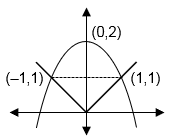
| (B) If the area enclosed by the curves x2 – y2 = 0 and x2 + y – 2 = 0 is ,where p and q are coprime then the value of (p – q), is | (Q) 4 |
|
(C) The curve that satisfies the differential equation is a hyperbola passing through (2, 1) with eccentricity e. The value of e4 is equal to |
(R) 6 |
| (D) Let if then the value of a, is | (S) 7 |
| (T) 8 |

Know your College Admission Chances Based on your Rank/Percentile, Category and Home State.
Get your JEE Main Personalised Report with Top Predicted Colleges in JoSA
(A) CS1 and CS2 divide the triangle into three of equal area so that S1 and S2 are points of trisection of AB. Thus S1 = (0, 0), S2 = (2, – 3). Equation of CS1 is y – x = 0. Slope of CS2 = – 4. The line through (0, 0) drawn parallel to CS2 is y + 4x = 0
Required equation is y2 + 3xy – 4x2 = 0 ⇒ λ + μ = 3 + 4 = 7
(B) The required area is bounded by the lines y = ± x and the parabola x2 = – (y – 2) having the vertex at (0, 2) and passing through (±1, 1). By symmetry about the y-axis,
⇒ p – q = 7 – 3 = 4
(C) With y = xv, xv' =
whose solution is x(1 – v2) = c. When x = 2, v =
The equation of the curve is x2 – y2 =
This is a rectangular hyperbola with eccentricity .
e4 = 4
(D)
In
In
In
⇒ a = 2