
| Column‑I | Column‑II |
| (A) A ray of light travelling along a line parallel to axis of parabola and moves along parallel to directrix after reflection from (1, 2) on surface of parabola. If focus of parabola is (2, 2 + ), then length of latus rectum will be | (P) 1 |
| (B) Area bounded by locus of centres of circles cutting = 1 orthogonally at (4, 3) with coordinates axes is equal to | (Q) 2 |
| (C) Tangent at upper end of latus rectum of y2 = 12x intersect ellipse at P and Q. If tangent at P and Q on ellipse intersect at (– 2α, α), then is equal to | (R) 3 |
| (D) will be minimum when α is greater than or equal to | (S) 4 |
| (T) 8 |

Know your College Admission Chances Based on your Rank/Percentile, Category and Home State.
Get your JEE Main Personalised Report with Top Predicted Colleges in JoSA
(A) Q Light rays after reflection passes through focus and reflected ray is parallel to directrix.
point (1, 2) will be one extremity of LR.
Length of LR
(B) Q Locus of centres of circles will be tangent to hyperbola at (4, 3)
i.e. = 1 ⇒ 3x – 2y = 6
Area bounded = × 2 × 3 = 3.
(C) Tangent at upper‑end (3, 6) will be y · 6 = 6 (x + 3) ⇒ x – y = – 3 ….…(1)
Equation of C.O.C. for (– 2α, α) w.r.t. ellipse is ….…(2)
(1) and (2) represent same line
⇒ a2 = 6α and b2 = 3α
(D) is equivalent of sum of distances of (α, 0) from (0, 3) and (7, 4).
For minimum value, (α, 0) will be point of intersection of line joining (7, 4) and (0, – 3) with x‑axis.
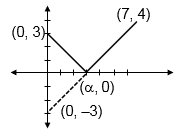
α = 3