
Question
A charged particle (electron or proton) is introduced at the origin (x = 0, y = 0, z = 0) with a given initial velocity . A uniform electric field and a uniform magnetic field exist everywhere. The velocity , electric field and magnetic field are given in columns 1, 2 and 3, respectively. The quantities E0, B0 are positive in magnitude.
|
Column 1 |
Column 2 |
Column 3 |
|
(I) Electron with |
(i) |
(P) |
|
(II) Electron with |
(ii) |
(Q) |
|
(III) Proton with |
(iii) |
(R) |
|
(IV) Proton with |
(iv) |
(S) |

Know your College Admission Chances Based on your Rank/Percentile, Category and Home State.
Get your JEE Main Personalised Report with Top Predicted Colleges in JoSA
In which case will the particle move in a straight line with constant velocity ?
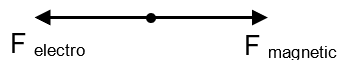
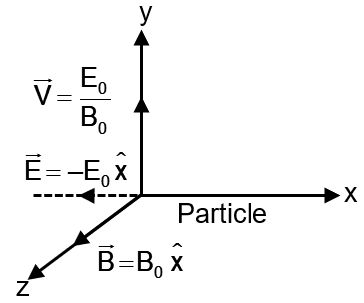
Felectro = q × E = – q E0 x
Fnet = EElectro + Fmagnetic = 0
Hence particle will move along straight line
In which case will the particle descirbe a helical path with axis along the positive z direction?
Force and velocity are perpendicular to each other.
In which case would the particle move in a straight line along the negative direction of y-axis (i.e., move along – )?