
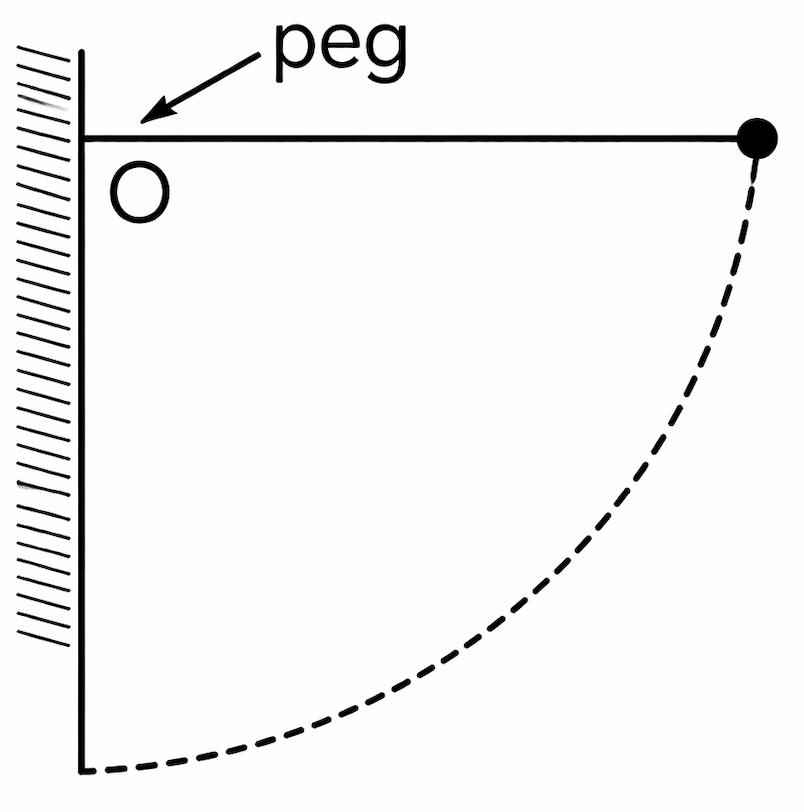
A simple pendulum is suspended from a peg on a vertical wall. The pendulum is pulled away from the wall to a horizontal position and released. The bob hits the wall with restitution coefficient being . What is the minimum number of impacts with the wall after which the maximum angular displacement becomes less than 60°?

Know your College Admission Chances Based on your Rank/Percentile, Category and Home State.
Get your JEE Main Personalised Report with Top Predicted Colleges in JoSA

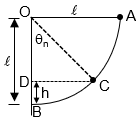
When the bob is at athe horizontal position A, its height above B = length of the string = ℓ . Therefore, potential energy at A = mgℓ . When the bob is released, it hits thewall at B and the enitre potentialenergy is converted into kinetic energy. If v is the velocity with which the bob hits wall, then
... (i)
Speed of the bob after the first rebound,
v1 = ev
Speed of the bob afte the second rebound,
v2 = ev1 = e2v
Speed of the bob after n rebounds, vn = env
If the ball rises to a position C at a height
h = BD afte n rebounds, then from the principle of conservation of energy, we have
... (ii)
Using eqn. (i) in (ii), we get
... (iii)
If θn is the angle the string subtends wtih vertical after n rebounds,it follows from figure that
h = OB – OD = ℓ – ℓ cos θn = (1 – cos θn) ... (iv)
From eq. (iii) and (iv), we have
ℓ e2n = ℓ (1 – cos θn) or e2n = (1 – cos θn)
From qn to be less than 60°, i.e. cos qn is greate than ,
(1 – cos θn) must be less than
Thus, e2n <
or (0.8)n < or n ln (0.8) < ln (0.5)
or – (0.0969) n < – 0.3010 or n >
or n > 3.1
The least integer treater than 3.1 is 4. Hence n = 4. Thus, after 4 impacts,the amplitude will becomes less than 60°.