Engineering
Physics
Curved Surface Refraction
Question

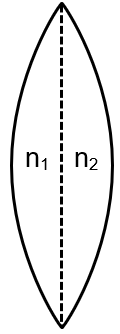
A thin convex lens is made of two materials with refractive indices n1 and n2, as shown in figure. The radius of curvature of the left and right spherical surfaces are equal. f is the focal length of the lens when n1 = n2 = n. The focal length is f + Δf when n1 = n and n2 = n + Δn. Assuming Δn << (n–1) and 1 < n < 2, the correct statement(s) is/are :
For n = 1.5, ∆n = 10–3 and f = 20 cm, the value of |Δf| will be 0.02 cm (round off to 2nd decimal place)

The relation between  Δff  and  Δnn remains unchanged if both the convex surfaces are replaced by concave surfaces of the same radius of curvature

|Δff|  <  |Δnn|

If Δnn<0  then  Δff>0

JEE Advance
College PredictorLive

Know your College Admission Chances Based on your Rank/Percentile, Category and Home State.

Get your JEE Main Personalised Report with Top Predicted Colleges in JoSA

Solution

When    n1 = n2 = n

 1f=(n−1)×2R

So       f=R2(n−1)                    ......(A)  

2nd case :

1f1=n−1R

1f2=(n+Δn)−1R

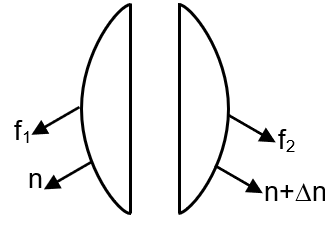
 1feq=1f+Δf=(n−1R)+(n+Δn)−1R=2(n−1)+ΔnR     

 Δf=(R2(n−1)+Δn) − (R2(n−1))

 =R2 [(n−1)−(n−1+Δn)(n−1 + Δn) (n−1)] = −Δn(n−1)2 × R2

 Δff=−Δn2(n−1)                       .....(B)

(A) Relation between Δff  and  Δnn is independent of R so (A) is correct.

(B) 2n – 2 < n because n < 2

 ⇒Δff=12 | Δnn−1 | > Δnn

So           Δff>  | Δnn |                   so (B) is wrong

(C)       |Δf|=fΔn(n−1)=(20 × 10−3)1.5−1=40 × 10−3=0.04

So (C) is wrong

(D) If Δnn<0   then  Δff>0 from equation (B)