
Question
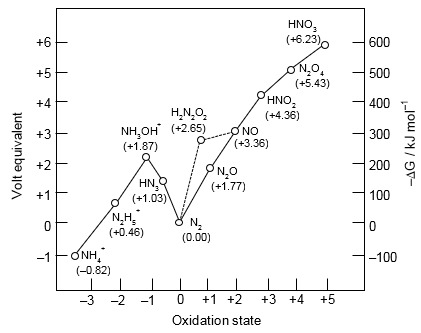
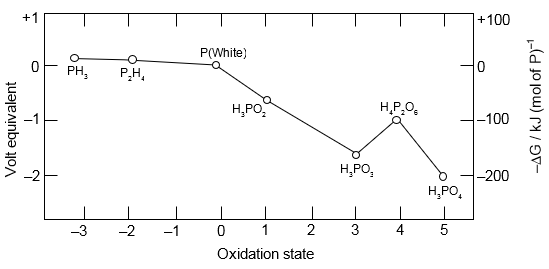
A volt-equivalent diagram is essentially a plot of free energy versus oxidation state. Two further points follows from these general considerations:
(a) A compound will tend to disproportionate into a higher and lower oxidation state if it lies above the line joining the 2 compounds in these oxidation state.
(b) Conversely, a compound can be formed by comproportionation of different compounds in which the element has a higher and lower oxidation state if it lies below the line joining these two.
(i) Volt equivalent diagram of compound or ions containing nitrogen in acidic aqueous medium.
(ii) Volt equivalent diagram of compound or ions containing phosphorus in acidic aqueous medium.

Know your College Admission Chances Based on your Rank/Percentile, Category and Home State.
Get your JEE Main Personalised Report with Top Predicted Colleges in JoSA
Synthesis of HN3 is done in acidic aqueous solution by reacting:

N2H5+ + HNO2 HN3
HN3 is synthesised by comproportionation of N2H5+ & HNO2 as HN3 lies below line joining N2H5+ & HNO2.
Select correct statement :
NH3OH+ N2O + NH4+
NH3OH+ disproportionates to form N2O and NH4+ as NH3OH+ lies above line joining N2O and NH4+.
Which of the following will decompose to form N2O and NH4+ in acidic aqueous solution:
NH3OH+ N2O + NH4+
NH3OH+ disproportionates to form N2O and NH4+ as NH3OH+ lies above line joining N2O and NH4+.