
Question
Let π1 denotes the equation of the plane to which the vector is normal and which contains the line L whose equation is π2 denotes the equation of the plane containing the line L and a point with position vector

Know your College Admission Chances Based on your Rank/Percentile, Category and Home State.
Get your JEE Main Personalised Report with Top Predicted Colleges in JoSA
The acute angle between π1 and π2, is
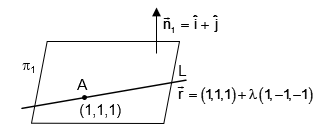
x + y = 2 ............ plane π1
Now, ; A(1, 1, 1); B(0, 1, 0)
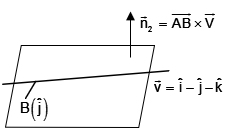
Now,
Hence, equation of plane π2 is = 0 or x + 2y – z = 2
If θ is the acute angle between π1 and π2 then
Vector of magnitude along the line of intersection of planes π1 and π2 and perpendicular to normal vector of plane π1, is
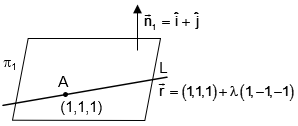
x + y = 2 ............ plane π1
Now, ; A(1, 1, 1); B(0, 1, 0)
Now,
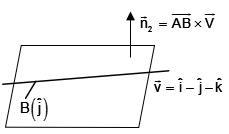
Hence, equation of plane π2 is = 0 or x + 2y – z = 2
Vector along the line of intersection of planes π1 and π2 is which is also perpendicular to the normal vector of plane π1.
So, required vector