Question
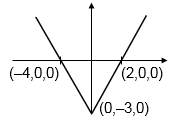
Let planes P1 : 3x + 4y + (k2 – 4)z = λ and P2 : –3x – ky + 6 = 0, where k, λR intersect the y-axis at a point whose distance from the origin is 3 units. The points (0, –4, 0) and (0, 0, 0) lie on opposite sides of both the planes.

Know your College Admission Chances Based on your Rank/Percentile, Category and Home State.
Get your JEE Main Personalised Report with Top Predicted Colleges in JoSA
If the plane perpendicular to P1 and parallel to z-axis and containing the point for exactly one real value of α is 8x + by + cz + d = 0, where b, c, dI then |b + c + d| equals
(ii) Plane perpendicular to the plane P1 and parallel to z-axis is 4x – 3y + q = 0
lies on the plane
2α – (2 – α2) + q = 0
α2 + 2α + q – 2 = 0
For exactly one real value of α
D = 0
⇒ 4 – 4 (q – 2) = 0 ⇒ q = 3
4x – 3y + 3 = 0
8x – 6y + 6 = 0 8x + by + cz + d = 0
b + c + d = 0.
The equation of the plane containing line of intersection of P1 and P2 and also a point whose position vector is
Putting x = z = 0 and y = 3 in the planes.
k = 2 and λ = 12
P1 : 3x + 4y – 12 = 0
and P2 : –3x – 2y + 6 = 0
But points (0, 0, 0) and (0, –4, 0)
lie on opposite sides of both the plane.
Putting x = 0 = z = 0 and y = –3
in the planes, k = –2 and λ = –12
P1 : 3x + 4y = –12 and
P2 : –3x + 2y + 6 = 0
(i) Required plane is P1 + tP2 = 0
3x + 4y + 12 + t (– 3x + 2y + 16) = 0
Putting (2, 3, 1), get t = – 5
18x – 6y – 18 = 0
⇒ 3x – y – 3 = 0.