
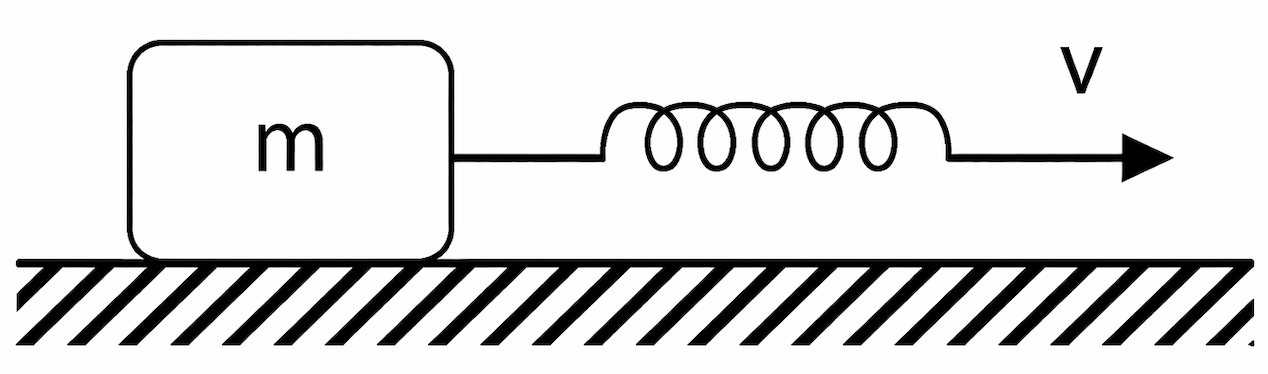
One end of an ideal spring is fixed to a block of mass m and the other end is free. The block is placed over a smooth horizontal floor. Initially the spring is unstressed and the block is at rest. Now the free end of spring is pulled to right with a constant horizontal velocity of magnitude v. For this given spring block system, match the statements given in column-I with statements in column-II.
| Column-I | Column-II |
| (A) When the length of spring is maximum | (P) the speed of block is v |
| (B) When the length of spring is minimum | (Q) the speed of block may be zero |
| (C) When the length of spring is equal to its natural length | (R) the speed of block may be 2v. |
| (D) When the net force on the block is zero. | (S) the kinetic energy of block may be maximum. |

Know your College Admission Chances Based on your Rank/Percentile, Category and Home State.
Get your JEE Main Personalised Report with Top Predicted Colleges in JoSA

From the frame of right end of spring at t = 0, the velocity of block is zero at extreme position.
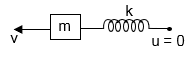
Hence at minimum or maximum length of spring, the speed of block is zero from given frame and v from ground frame.
When the block is at mean position or spring is in natural length, from frame of right end of spring the velocity of block is either v towards left or v towards right.
Hence from ground frame the speed of block is either 0 or 2v.