
Engineering
Physics
Electric Flux and Gauss Law and its Applications
Question
The electric field E is measured at a point P(0, 0, d) generated due to various charge distributions and the dependence of E on d is found to be different for different charge distributions. List-I contains different relations between E and d. List-II describes different electric charge distributions, along with their locations. Match the functions in List-I with the related charge distributions in List-II.
| List - I | List - II |
| (P) E is independent of d | (1) A point charge Q at the origin |
| (Q) | (2) A small dipole with point charges Q at (0, 0, l) and – Q at (0, 0, l). Take 2l << d |
| (R) | (3) An infinite line charge coincident with the x axis, with uniform linear charge density λ |
| (S) | (4) Two infinite wires carrying uniform linear charge density parallel to the x-axis. The one along (y = 0, z = l) has a charge density +λ and the one along (y = 0, z = – l) has a charge density –λ. Take 2l << d |
| (5) Infinite plane charge coincident with the xy-plane with uniform surface charge density |

Know your College Admission Chances Based on your Rank/Percentile, Category and Home State.
Get your JEE Main Personalised Report with Top Predicted Colleges in JoSA
Solution
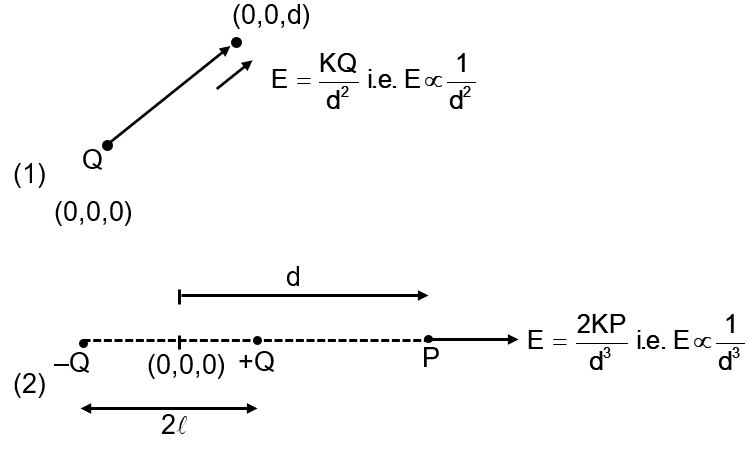
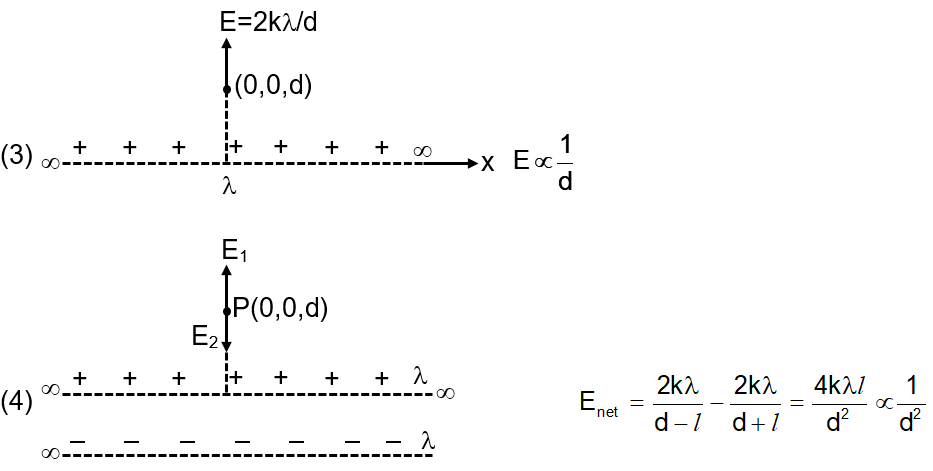
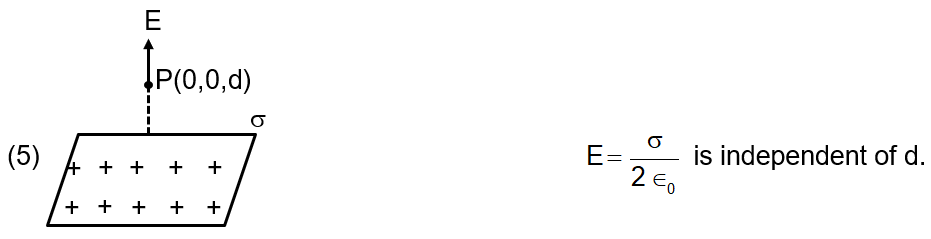
(P) → 5 ; (Q) → 3 ; (R) → 1, 4 ; (S) → 2
So option (B)