
Question
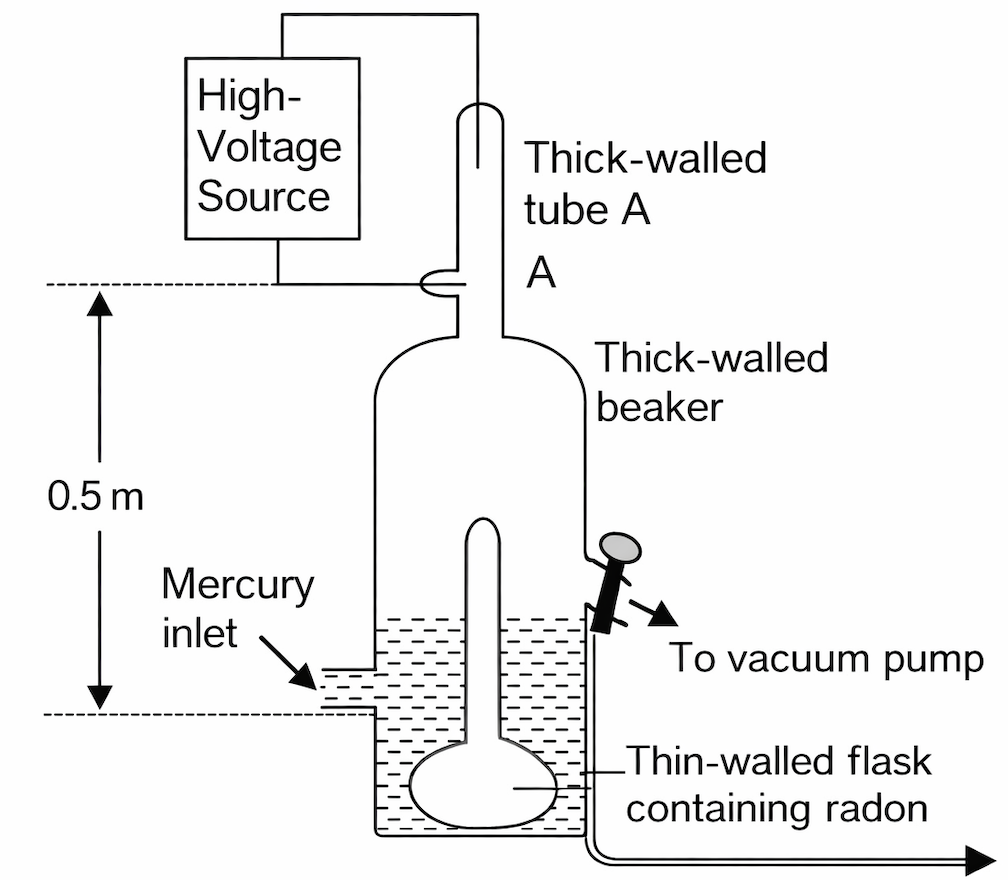
The Rutherford - Royds experiment. The following experiment dates from 1909. The apparatus is shown below. The thin - walled glass flask, containing radon (an a emitter), is placed inside the thick-walled glass apparatus. The apparatus is evacuated, and the valve to the vacuum pump is then closed. After a week, additional mercury is added to the apparatus until the liquid level reaches the bottom of the tube. A high-voltage discharge is then passed through the tube, and the light emitted is observed with a spectrometer. The flask emits a-particles when Radon decays according to equation
with a half life of 3.5 days. The flask contained 222 gm of radioactive Radon. We can assume that half of the a-particles emitted accumulate in the empty space above mercury. The volume of tube is 1 litre. Take density of mercury as 13.6 gm/cc. Assume that a-particles can combine with 1 free electron or 2 free electrons to form Helium gas, or singly ionized Helium in ground state.
(Take : Atmospheric pressure 105 Pa, temperature = 27°C, R = 25/3 J/mol-K)

Know your College Admission Chances Based on your Rank/Percentile, Category and Home State.
Get your JEE Main Personalised Report with Top Predicted Colleges in JoSA
What is the pressure at point A.

PV = nRT ⇒ P × 10–3 = ⇒ P = 9.375
How many moles of Helium gas is present in the capillarly tube.
Number of nuclei decayed =
Given that half of α-particle emitted accumulate in the empty space above mercury.
So no. of moles of He gas
What should be the minimum voltage of the discharge to obtain spectra emitted by singly ionized Helium gas ?