
Question
The wave function ψn.ℓ,mℓ is a mathematical function whose value depends upon spherical polar coordinates (r,θ,φ) of the electron and characterized by the quantum numbers n,ℓ and mℓ. Here r is distance from nucleus, θ is colatitude and φ is azimuth. In the mathematical functions given in the Table, Z is atomic number and a0 is Bohr radius.
| Column 1 | Column 2 | Column 3 |
| (I) 1 s orbital | 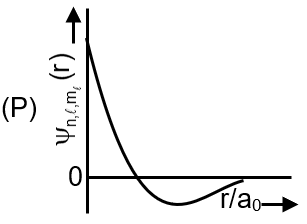 |
|
| (II ) 2s orbital | (ii) One radial node | (Q) Probability density at nuvleus |
| (III) 2pz orbital | (R) Probability density is maximun at nucleus | |
| (IV) 3dz2 orbital | (iv) xy- plane is a nodal plane |
(S) Energy needed to excite electron from n=2 state to n=4 state is times the energy needed to excite electron from n=2 state |

Know your College Admission Chances Based on your Rank/Percentile, Category and Home State.
Get your JEE Main Personalised Report with Top Predicted Colleges in JoSA
For He+ ion, the only INCORRECT combination is
For He+ ion
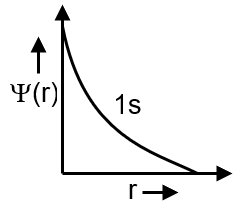
(A) For 1s-orbital,
and probability density =
s-orbital has no angular node.
(I) (i) (R) is correct combination
(B) For 2s-orbital. There us one radial node &
Probability density
(II) (ii) (Q) is correct combination
(C) For 1s-orbital :
= (–0.85 + 3.4) × 22 eV
= (2.55 × 22 )eV
= 3.022 × 22 eV
× 3.022 × 22 = 2.55 × 22
(I) (i) (S) is correct combination
(D) For 1s-orbital :
(I) (iii) are incorrect combination
Answer (D)
For the given orbital in column 1, the only CORRECT combination for any hydrogen-like species is
For 2s-orbital :
Number of radial node = 1
& probability density at nucleus =
i.e. probability density at nucleus
(II) (ii) (P) is incorrect combination
Answer (D)
For hydrogen atom, the only CORRECT combination is
(D) For 1s-orbital :
(E2→4)H = (–0.85 + 3.4) eV = 2.55 eV
= 3.022
But, 3.022 ×= 2.55
(I) (i) (S) is correct combination
Answer (D)