
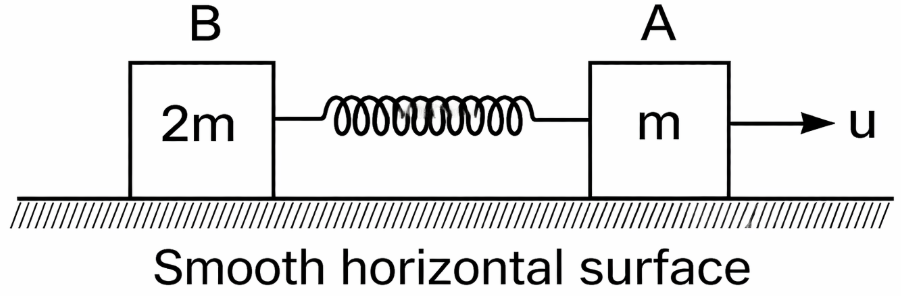
Two blocks A and B of mass m and 2m respectively are connected by a massless spring of spring constant k. This system lies over a smooth horizontal surface. At t = 0 the block A has velocity u towards right (as shown) while speed of block B is zero, and the length of spring is equal to its natural length at that instant.
| Column-I | Column-II |
| (A) The velocity of block A | (P) Can never be zero |
| (B) The velocity of block B | (Q) May be zero at a certain instant of time |
| (C) The kinetic energy of system of two blocks | (R) Is minimum at maximum compression of spring |
| (D) The potential energy of spring | (S) Is maximum at maximum extension of spring |
| (T) Will vary sinusoidal with time. |

Know your College Admission Chances Based on your Rank/Percentile, Category and Home State.
Get your JEE Main Personalised Report with Top Predicted Colleges in JoSA

This system undergoes simple harmonic motion about the center of mass, which remains stationary. The center of mass velocity is constant: . The blocks oscillate relative to the center of mass.
(A) Velocity of A: Varies sinusoidally around u/3. It can be zero. (Q, T)
(B) Velocity of B: Varies sinusoidally around u/3. It can be zero. (Q, T)
(C) Kinetic Energy: Minimum when spring PE is maximum (at max compression/extension). (R)
(D) Potential Energy: Maximum at maximum compression AND extension. (S)
Final Answer: A → Q, T; B → Q, T; C → R; D → S