
Engineering
Physics
Curved Surface Refraction
Question
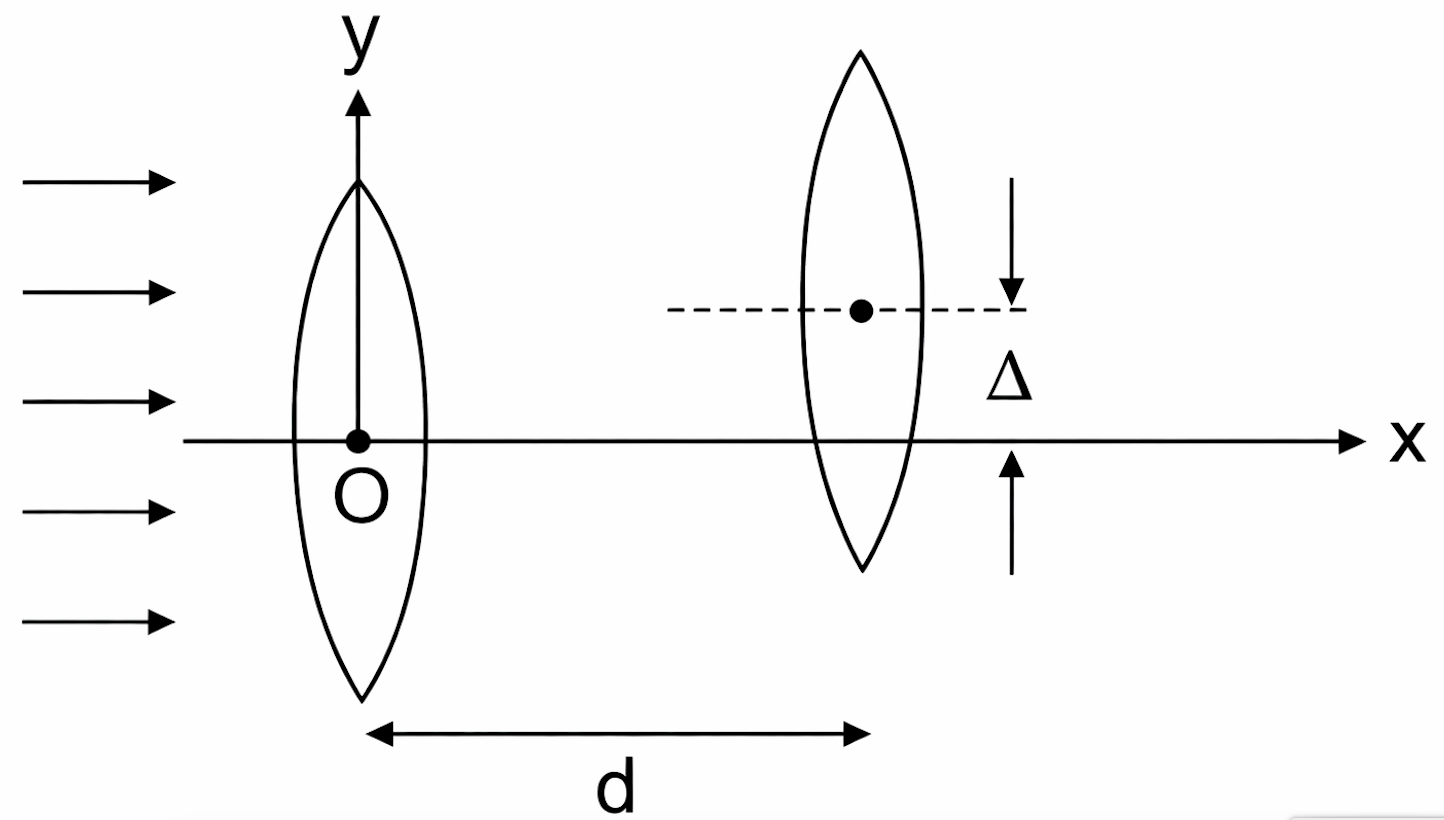
Two thin convex lenses of focal lengths f1 and f2 are separated by a horizontal distance d (where d < f1 < f2) and their centres are displaced by a vertical separation D as shown in the figure. Taking the origin O, at the centre of first lens, the x and y co-ordinate of the focal point of this lens system, for a parallel beam of rays coming from the left, are given by

Know your College Admission Chances Based on your Rank/Percentile, Category and Home State.
Get your JEE Main Personalised Report with Top Predicted Colleges in JoSA
Solution
Lens -1
v' is the object for f2
u2 = f1 – d
from the first lens the final image is at a distance