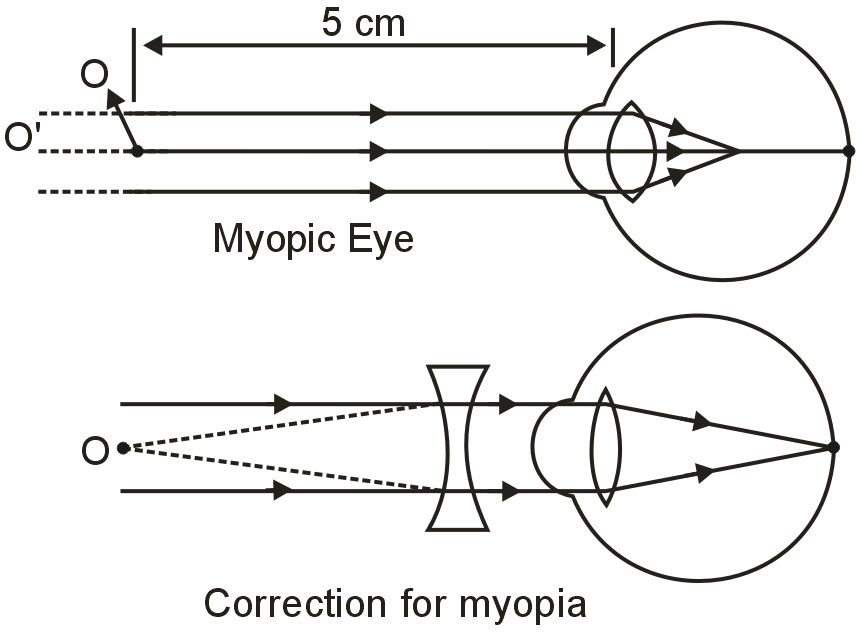
(a) A student suffering from myopia is not able to see distinctly the objects placed beyond 5m. List two possible reasons due to which this defect of vision may have arisen. With the help of ray diagrams, explain
(i) why the student is unable to see distinctly the objects placed beyond 5m from his eyes.
(ii) the type of the corrective lens used to restore proper vision and how this defect is corrected by the use of this lens.
(b) If, in this case, the numerical value of the focal length of the corrective lens is 5m, find the power of the lens as per the new Cartesian sign convention.

Know your College Admission Chances Based on your Rank/Percentile, Category and Home State.
Get your JEE Main Personalised Report with Top Predicted Colleges in JoSA

(a) Myopia is also known as near-sightedness. A person with myopia can see nearby objects clearly but cannot see distant objects distinctly. A person with this defect has the far point nearer than infinity. Such a person may see clearly upto a distance of a few metres. In a myopic eye, the image of a distant object is formed in front of the retina and not at the retina itself. This defect may arise due to : (1) excessive curvature of the eye lens, or (2) elongation of the eyeball.