
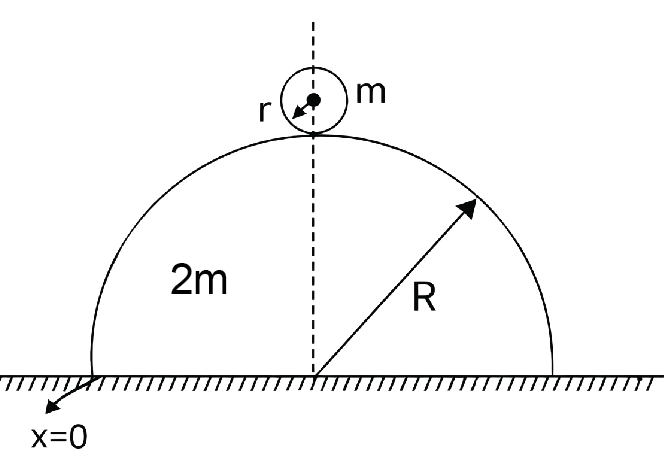
A small sphere of radius r and mass m is placed on a big hemisphere of mass 2m and radius R which is kept on a smooth horizontal surface as shown in the figure. Find the displacement of hemisphere when line joining between centre of small sphere and centre of big hemisphere makes 30º with the vertical (initially this line was vertical and assume small sphere is not losing the contact with hemisphere)

Know your College Admission Chances Based on your Rank/Percentile, Category and Home State.
Get your JEE Main Personalised Report with Top Predicted Colleges in JoSA
Since the horizontal surface is smooth, the center of mass (COM) of the entire system remains fixed horizontally. Initially, the COM's horizontal position is calculated from the leftmost point. Let the hemisphere's COM be at its center, a distance R from its left edge. The small sphere is at the top, so its horizontal position is also R from the left edge. The total mass is 3m.
The initial horizontal COM, Xcom = (2m * R + m * R) / 3m = R.
Finally, when the line makes 30° with the vertical, the small sphere has moved. Its new horizontal position relative to the hemisphere's center is (R + r) sin 30° = (R + r)/2. If the hemisphere has moved a distance x to the right, the sphere's absolute horizontal position is R + x + (R + r)/2.
Setting the final COM position equal to the initial (R) gives: (2m * x + m * [R + x + (R + r)/2]) / 3m = R. Solving for x yields x = (R + r)/6.
Final Answer: