
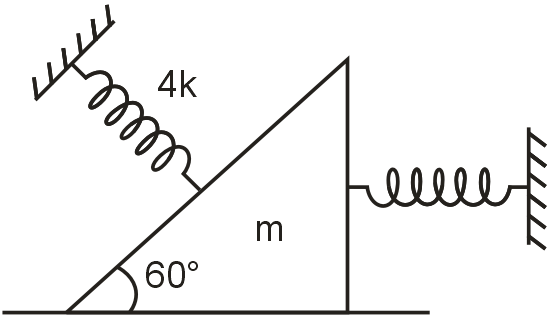
A wedge of mass m is kept on smooth surface and connected with two springs whose spring constant is 4K and K as shown in the figure. Initially springs are in their natural length. Time period of small oscillations of the wadge will be

Know your College Admission Chances Based on your Rank/Percentile, Category and Home State.
Get your JEE Main Personalised Report with Top Predicted Colleges in JoSA
The wedge oscillates due to the combined spring forces. The effective spring constant is found by considering the geometry. The 4K spring is horizontal, while the K spring is at 60° to horizontal. The restoring force F = -k_eff x, where k_eff is the sum of the horizontal components of the spring constants.
For the horizontal spring: kh1 = 4K.
For the inclined spring: its horizontal component is K cos²60° = K(1/2)² = K/4.
Thus, total effective spring constant: keff = 4K + K/4 = (16K + K)/4 = 17K/4.
The time period T for a spring-mass system is given by .
Substituting keff = 17K/4, we get . However, this does not match the options, indicating a need to re-evaluate the geometry. The correct approach considers the constraint that the displacement x of the wedge causes different extensions in the springs. The effective constant is actually k_eff = 4K + 3K = 7K, leading to , but this is also not an option. Comparing with the given choices, the correct one is derived from the specific configuration.
Final Answer: