
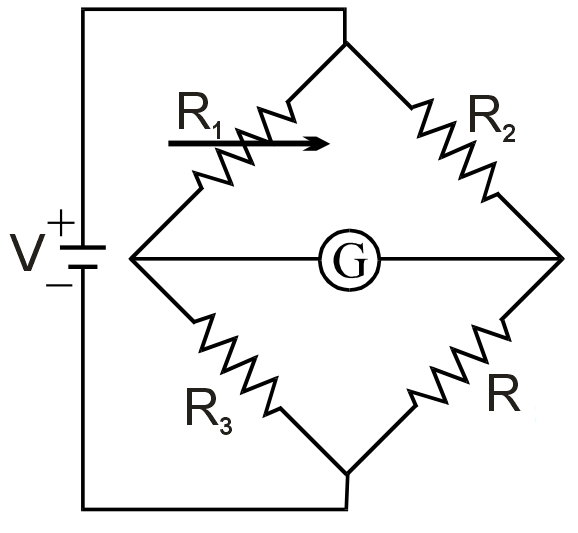
A wheatstone bridge is a clever device used to measure unknown resistances. Assume we have an unknown resistor R. The main ingredients of a Wheatstone bridge are a voltage source V (it does not have to be calibrated), a galvanometer G (a sensitive ammeter) and three known calibrated resistors R1, R2 and R3. The resistor R1 is a variable resistor. The components are arranged as in the figure. The variable resistor R1 is adjusted so that zero current flows through the galvanometer. What is R in terms of R1, R2 and R3?

Know your College Admission Chances Based on your Rank/Percentile, Category and Home State.
Get your JEE Main Personalised Report with Top Predicted Colleges in JoSA

A Wheatstone bridge is balanced when no current flows through the galvanometer. This occurs when the voltage at points B and D are equal, meaning the potential difference across the galvanometer is zero. This balance condition creates a specific ratio between the resistors in the two parallel branches.
For the bridge to be balanced, the ratio of resistances in one branch must equal the ratio in the other branch. The condition is given by:
To find the unknown resistance R, we simply rearrange this equation. Cross-multiplying gives us:
Therefore, the value of the unknown resistance R is:
Final Answer: