Engineering
Physics
Conservation of Energy
Basics of Simple Harmonic Motion
SHM of Spring Block System
Question
Define linear S.H.M. Obtain differential equation of linear S.H.M.

Know your College Admission Chances Based on your Rank/Percentile, Category and Home State.
Get your JEE Main Personalised Report with Top Predicted Colleges in JoSA
Solution

Linear SHM is the simplest Kind of oscillatory motion in which a body when displaced from its mean position, oscillates 'to and fro' about mean position and the restoring force (or acceleration) is always directed towards its mean position and its magnitude is directly proportional to the displacement from the mean position.
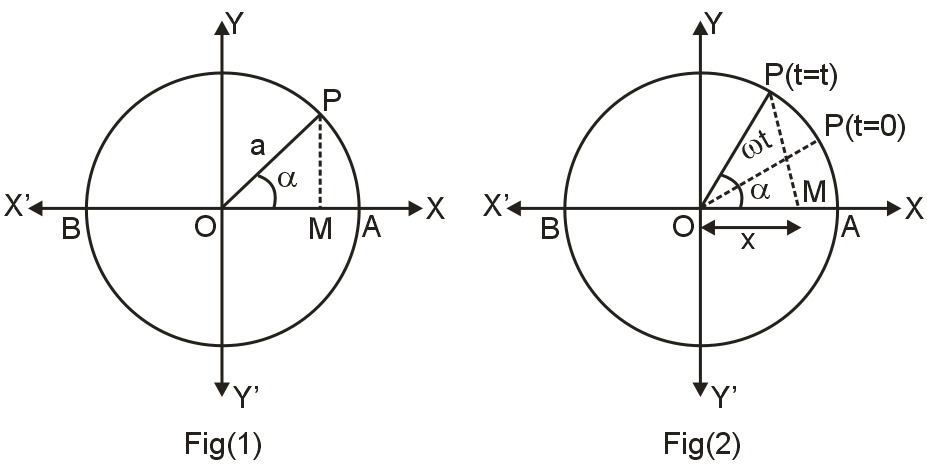
Consider particle P moving along the circumference of a circle of radius 'a' with a uniform angular speed of ω in the anticlockwise direction.
Refer image (1)
Particle P along the circumference of the circle has its projection particle on diameter AB at point M. This projection particle follows linear SHM along line AB when particle P rotates around the circle.
Let the rotation start with initial angle 'α' as shown above (t = 0)
In time 't' the angle between OP and X-axis will become (ωt + α) as shown below:
Refer image (2)
Now from
⇒ x = acos(ωt + α) ...(i)
Differentiating above equation with respect to time
we get velocity
...(ii)
Differentiating again we get acceleration
= –acos(ωt + α)ω2
= –ω2x ...(iii)
as x = acos(ωt + α)
Equation (i),(ii) and (iii) are differential equations for linear SHM.