Medical
Biology
PCR and Bioreactors
Genetic Code and Mutation
Transcription
Question
Describe the steps of PCR technique.

Know your College Admission Chances Based on your Rank/Percentile, Category and Home State.
Get your JEE Main Personalised Report with Top Predicted Colleges in JoSA
Solution

Polymerase Chain Reaction or PCR was developed by Karry Mullis in 1983. It is a technique to amplify DNA i.e. to make a large number of copies of DNA.
Requirements for PCR:
- Sample DNA (DNA which has to be amplified)
- Primers
- dNTPs (dATP, dTTP, dCTP, dGTP)
- Thermostable enzyme Taq Polymerase
- Thermocycler machine in which PCR has to be carried out.
Steps in PCR:
The PCR cycle has following three steps:
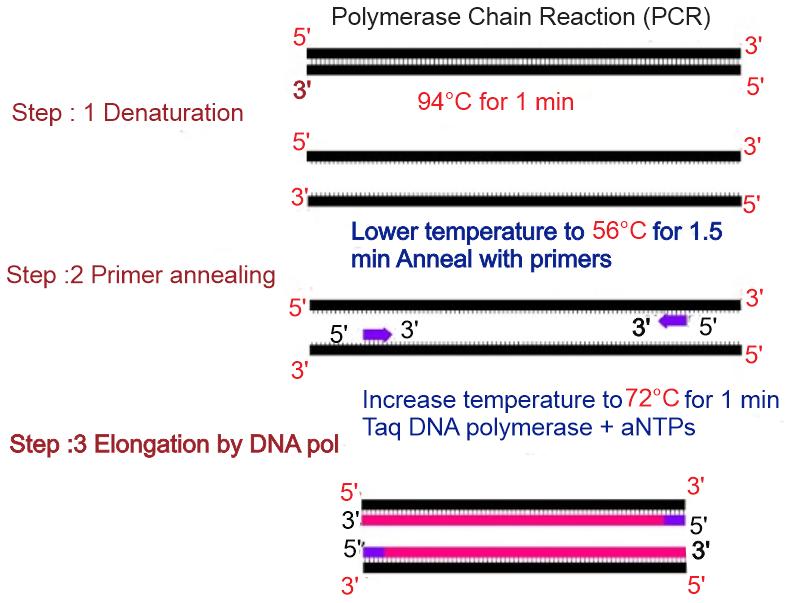
1. Denaturation: In this step, the two strands of double-stranded DNA are separated by heating to 94°C for 2 minutes. The two strands separate because the hydrogen bonds between the base pairs break.
2. Annealing: This step involves the binding of primers (short lengths of DNA about 20 bp long) to the 3' end of the single strands of DNA. The temperature of the reaction is lowered to 56°C so that the primers can anneal to the complementary sequences of the separated single strands of DNA.
3. Extension: In this step, the temperature of the reaction is raised to 72°C. The primers are extended by the enzyme Taq Polymerase. This enzyme is derived from the thermophilic bacteria Thermus aquaticus. This enzyme is stable at high temperatures even at 90°C. The enzyme adds nucleotides to the 3' end of the primers and extends them until a DNA strand which is complementary to the template DNA is formed.
Thus, one PCR cycle is completed and the amount of DNA doubles and so on.