Know your College Admission Chances Based on your Rank/Percentile, Category and Home State.
Get your JEE Main Personalised Report with Top Predicted Colleges in JoSA
Robert Brown in 1831 discovered the nucleus in the cell.
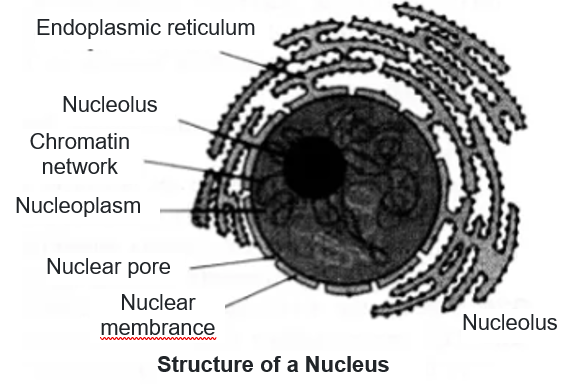
Structure: The nucleus is of large size, more dense, spherical or oval and prominent organelle of the cell.
The structure of the nucleus can be divided into three parts:
1. Nuclear membrane: Nucleus is enclosed by a double-layered nuclear membrane. In bacteria and blue-green algae, the nuclear membrane is not found.
2. Nucleoplasm: In nucleus is present a thick jelly-like semi-fluid nucleoplasm. In nucleus a network of fine thread-like structures called chromatin network is present. At the time of cell division, the chromatin forms structures called chromosomes. The number of chromosomes is fixed for every species of animals and plants. The man has 23 pairs of chromosomes. Wheat has 21 pairs of chromosomes. The two partners of chromosomes pair are called homologous chromosomes.
→ Chromosomes: Chromosomes are composed of specific proteins and a nucleic acid called Deoxyribose Nucleic Acid (DNA) Genes are segments of DNA. Genes control and carry the hereditary characters.
3. Nucleolus: Nucleolus contains RNA, commonly there is a single nucleolus, but two or more may be present. The nucleolus is the seat for the synthesis of cytoplasmic Ribosomes. During cell, division nucleolus disappears in early stages and reappears on the same location in the daughter nuclei.
The functions of the nucleus are as follows:
1) The nucleus controls the activities of the cell, through its DNA molecule.
2) The main function of the nuclear reticulum is participation in cell-division.
3) Genes are located in a linear fashion in chromosomes. The genes are composed of DNA. Genes control and carry the hereditary characters from one generation to another generation.
4) Nucleolus assists in protein synthesis. Formation of ribosomes takes place in the nucleolus.