Know your College Admission Chances Based on your Rank/Percentile, Category and Home State.
Get your JEE Main Personalised Report with Top Predicted Colleges in JoSA

The nephron is the filtration unit of the kidney.
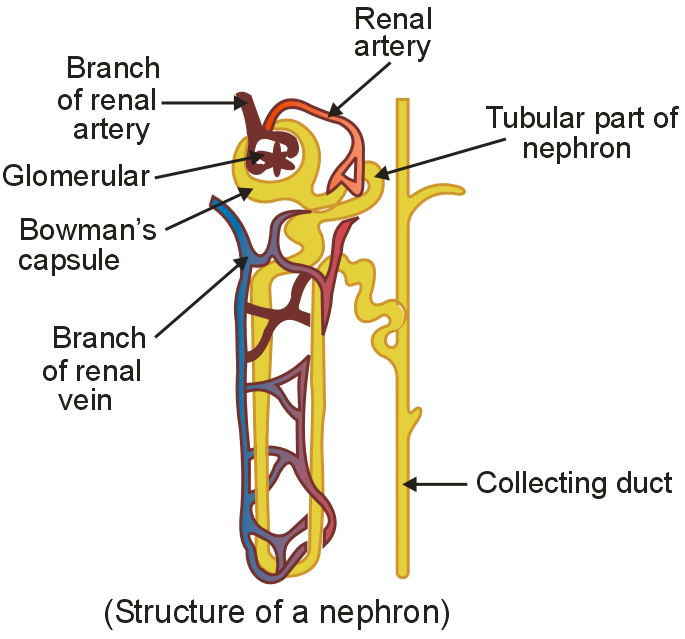
It consists of a tubule that is connected with collecting duct at one end and a cup-shaped structure at the other end. This cup-shaped structure is called ‘Bowman’s capsule’. Every Bowman’s capsule contains a cluster of capillaries, called ‘Glomerulus’, within the cup-shaped structure. The blood enters into Glomerulus through afferent arteriole of the renal artery and leaves it through the efferent arteriole. Together, the glomerulus and its surrounding Bowman's capsule are called a renal corpuscle.
Blood enters the glomerulus through a small artery supplying the glomerulus with unfiltered blood called the afferent arteriole. Another vessel, a small artery carrying filtered blood away from the glomerulus, is called the efferent arteriole. These two arterioles play a key role in helping the glomeruli's capillaries perform the process of ultrafiltration.
Nephron starts from Bowman’s capsule and consists of the following parts : proximal convoluted tubule (in the renal cortex), the loop of Henle (in the renal medulla), and distal convoluted tubule (in the renal cortex).
(i) The loop of Henle : It is U shaped middle portion of renal tubules. It is composed of ascending and descending loop. Ascending loop is thick-walled and impermeable to water while the descending loop is thin-walled and permeable to water. The countercurrent mechanism is a crucial role of the loop of Henle.
(ii) proximal convoluted tubules (PCT) : it is a proximal part of renal tubules next to Bowman’s capsule. It is lined with microvilli. Maximum reabsorption of water, glucose, amino acids and electrolytes takes place here.
(iii) Distal convoluted tubules (DCT) : It is the distal part of renal tubules that lead to collecting ducts. It is similar in structure and function with PCT.
Functioning of Nephron :-
1. Filtration : Filtration of blood takes place in Bowman’s capsule from the capillaries of the glomerulus. The filtrate passes into the tubular part of the nephron. This filtrate contains glucose, amino acids, urea, uric acid, salts and a major amount of water.
2. Re-absorption : As the filtrate flows along the nephrons, substances such as glucose, amino acids, salts, and water are selectively re-absorbed into the blood by capillaries surrounding the nephron tube the leadule.
The amount of water re-absorbed depends on the need of the body and also on the amount of wastes to be excreted.
3. Urine : The filtrate which remains after re-absorption is called urine. Urine contains dissolved nitrogenous waste, i.e. urea and uric acid, excess salts and water. Urine is collected from nephrons by the collecting duct to carry it to the ureter.