Explain the C4 cycle of photosynthesis.

Know your College Admission Chances Based on your Rank/Percentile, Category and Home State.
Get your JEE Main Personalised Report with Top Predicted Colleges in JoSA

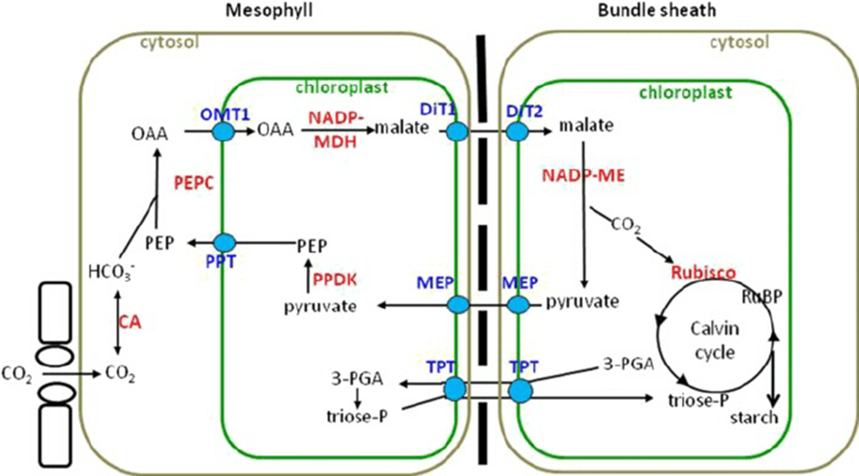
This pathway mostly takes place in monocot plants and in some dicot plants. In this pathway, the first product of CO2 fixation is a 4 carbon compound, oxaloacetic acid, hence it is called C4 pathway.
The anatomy of leaves of C4 plants is different from leaves of C3 plants (Calvin cycle). Palisade cells in the mesophyll tissues are absent. There is bundle sheath around the vascular bundles. In the bundle sheath cells, large chloroplasts without grana or less developed grana are present, whereas, in mesophyll cells, there are chloroplasts with well-developed grana. This type of anatomy is called Kranz anatomy.
In C4 pathway, CO2 taken from the atmosphere is accepted by phosphoenol pyruvic acid present in the chloroplast of mesophyll cells, leading to the formation of a 4 carbon compound oxaloacetic acid. This is converted into malic acid (4 carbon compound) which enters into the chloroplast of bundle sheath cells. Here the malic acid dissociates into pyruvic acid and CO2. Pyruvic acid re-enters with RuBP gives rise to sugars and other carbohydrates in bundle sheath cells. There is no photorespiration in these plants. Example, Maize, Sorghum.