Medical
Biology
Glycolysis
Aerobic Respiration
Dark Reaction
Question
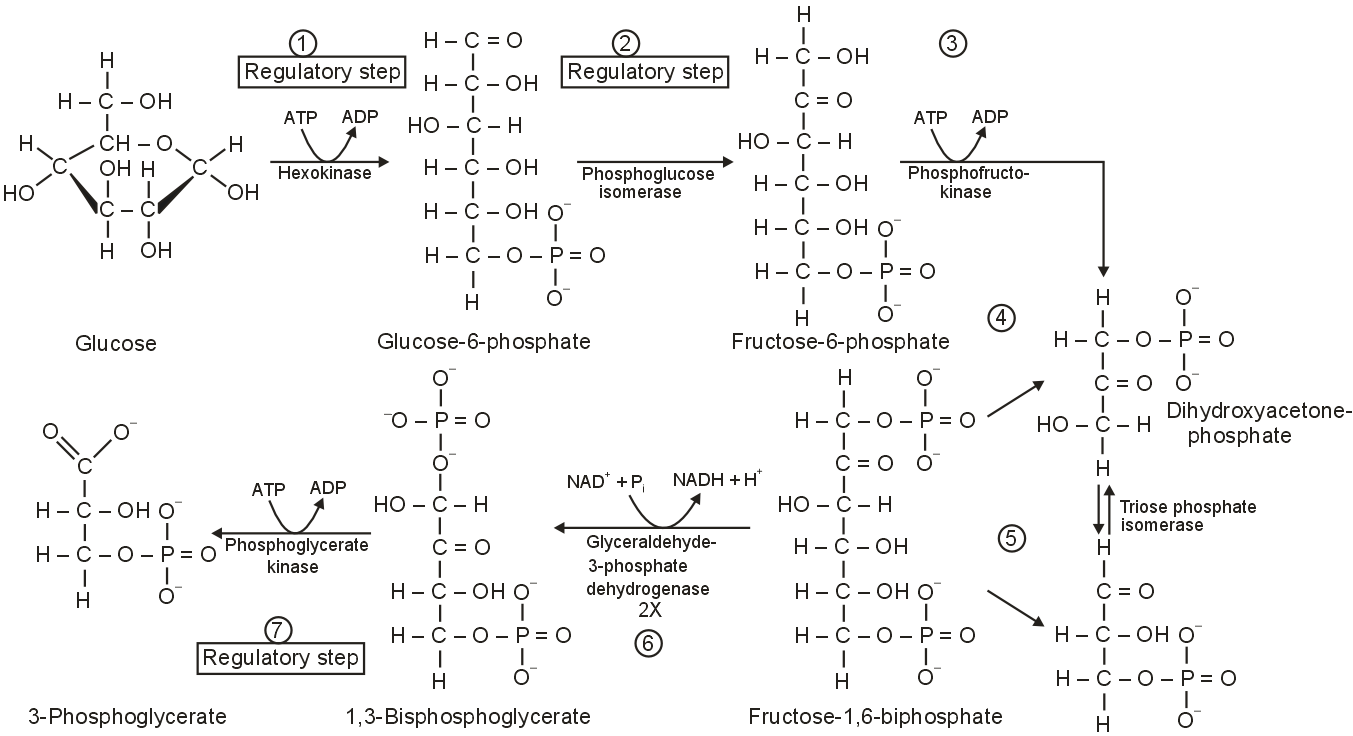
Explain the major steps of Glycolysis. Why does this process occur in a cell?

Know your College Admission Chances Based on your Rank/Percentile, Category and Home State.
Get your JEE Main Personalised Report with Top Predicted Colleges in JoSA
Solution

Glycolysis is the metabolic process by which glucose is converted into pyruvate. This is the foundation for both aerobic and anaerobic cellular respiration. It results in the formation of energy-rich molecule ATP. It occurs in 10 steps.
Step I : The first step in glycolysis is the conversion of D-glucose into glucose-6-phosphate. Hexokinase enzyme catalyzes this reaction.
Step II : In this, the rearrangement of glucose 6-phosphate (G6P) into fructose 6-phosphate (F6P) takes place by glucose phosphate isomerase enzyme.
Step III : Phosphofructokinase enzyme in presence of Mg+ ion converts fructose 6-phosphate into fructose 1,6-bisphosphate.
Step IV : Enzyme Aldolase splits fructose 1, 6-bisphosphate into two sugars, namely dihydroxyacetone phosphate (DHAP) and glyceraldehyde 3-phosphate (GAP).
Step V : Enzyme triophosphate isomerase interconverts the dihydroxyacetone phosphate (DHAP) into glyceraldehyde 3-phosphate (GAP).
Step VI : Enzyme glyceraldehyde-3-phosphate dehydrogenase converts glyceraldehyde 3-phosphate into 1,3-bisphosphoglycerate. In this step, NADH+ is formed.
Step VII : Enzyme phosphoglycerate kinase converts 1,3-bisphosphoglycerate to 3-phosphoglycerate. In this step, ATP is formed.
Step VIII : Enzyme phosphoglyceromutase converts 3- phosphoglycerate to 2-phosphoglycerate.
Step IX : Enzyme enolase removes a molecule of water from 2-phosphoglycerate to form phosphoenolpyruvic acid (PEP).
Step X : Enzyme pyruvate kinase 2 molecules of pyruvic acids are formed from phosphoenolpyruvate (PEP). In this step, ATP is formed.