Give analytical treatment of YDSE interference bands and hence obtain the expression for fringe width.

Know your College Admission Chances Based on your Rank/Percentile, Category and Home State.
Get your JEE Main Personalised Report with Top Predicted Colleges in JoSA

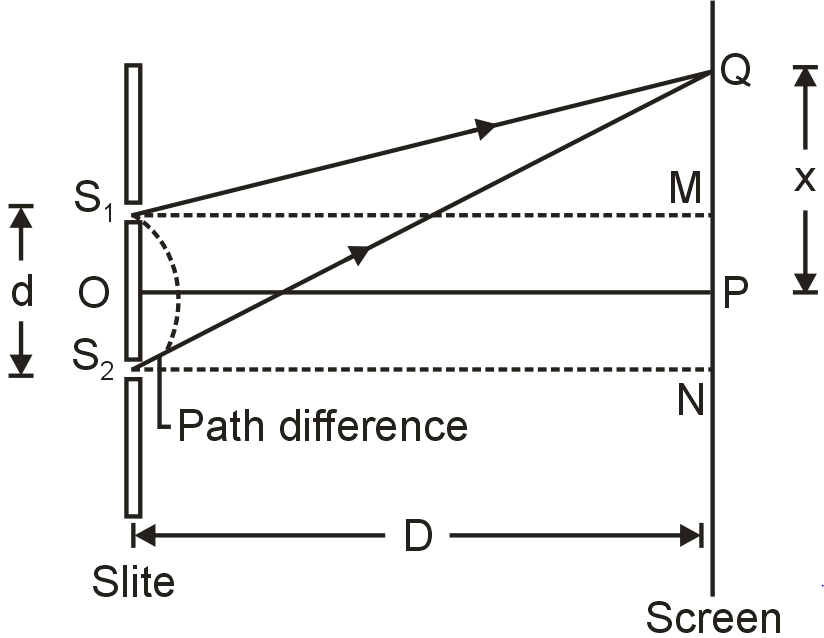
Let us consider young's double slit experimental setup. Two narrow coherent light sources are obtained by wavefront splitting as mono chromatic light of wavelength λ emerges out of two closely spaced, parallel slits S1 and S2 of equal widths. The separation S1S2 = d is very small. The interference pattern is observed on a screen placed parallel to the plane of S1S2 and some considerable distance.
D(D << d) from the slits. OP is the perpendicular bisector of segment S1S2. Consider point Q on the screen at a distance x from P(x >> D) the two light waves from S1, S2 reach Q along paths S1 Q and S2 Q respectively.
From the figures
.....(1)
and .....(2)
In partice, D << x and D << d, so that
S2Q – S1Q ≃ 2D
∴ Path difference, .....(3)
Expression for the fringe width or band width: The distance between consecutive bright(or dark) fringes is called the fringe width or band width X.
Point Q will be bright(maximum intensity), if the path difference , where n = 0, 1, 2, 3.....
point Q will be dark(minimum intensity equal to zero) if , where m = 1, 2, 3.....
These conditions show that the bright and dark fringes occur alternately and are equally speed.
For point P, the path difference (S2P – S1P) = 0. Hence, point P will be bright, the central bright fringe or band. On both sides of point P, the interference pattern consists of alternate bright and dark bands or fringes parallel to the slit.
Let xn and xn + 1 be the distances of the nth and (n + 1)th bright fringes from the central bright fringe.
or ....(4)
and or ....(5)
∴ The distance between consecutive bright fringes
....(6)