
Question
Suppose we consider friction between string and the pulley while still considering the string to be massless. So, in such a theoretical case, the tension in the string in contact with the pulley will not be constant and its variation is calculated as follows:
If the string is just on the verge of slipping on the pulley, then friction acting is limiting and if T2 > T1 then friction will act towards T1 in tangential direction as shown.
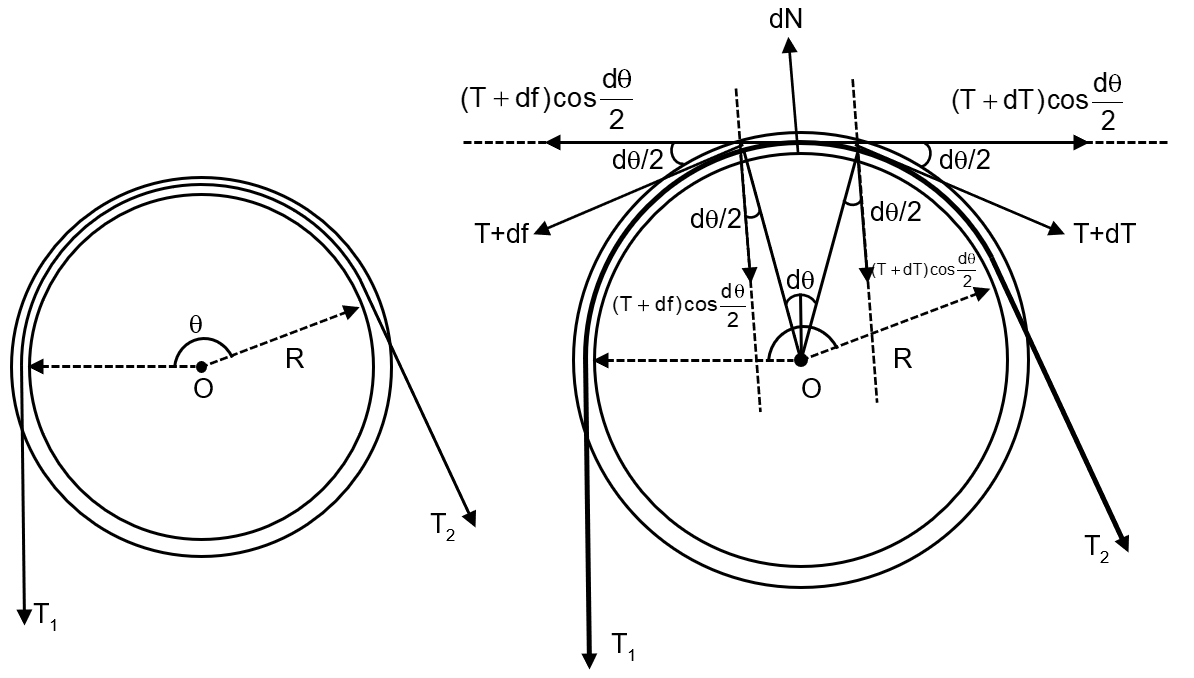
dN = (T + df) sin (dθ/2) + (T + dT) sin (dθ/2)
dN = T sin (dθ/2) + df sin (dθ/2) + T sin (dθ/2) + dT sin (dθ/2)
dN ≈ 2T sin (dθ/2)
dN ≈ 2T
dN = Tdθ ... (1)
Also, (T + df) cos = (T + dT) cos
T cos + df cos = T cos + dT cos
df = dT = µdN ... (2)
from (1) & (2),
dT = µTdθ
T2 = T1eµθ , where θ is the angle of contact between the string and the pulley.
Based on above information, answer the following questions.

Know your College Admission Chances Based on your Rank/Percentile, Category and Home State.
Get your JEE Main Personalised Report with Top Predicted Colleges in JoSA
Figure shows a cylinder mounted on an horizontal axle. A massless string is wound on it with two and a half turns and connected to two masses m and 2m. If the system is in limiting equilibrium, find the coefficient of friction between the string and the pulley surface.
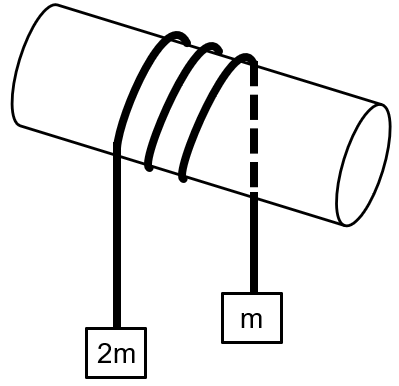

If the system is in equilibrium, the tensions in two hanging parts of the string will be mg and 2mg respectively. From equation, we have
2mg = mg eµ(5π) [As the angle of contact = 5π
Two masses m1 kg and m2 kg passes over an atwood machine. Find the ratio of masses m1 and m2 so that string passing over the pulley will just start slipping over its surface. The friction coefficient between the string and pulley surface is 0.2.
For a simple atwood's machine we can write for the two masses
m1g – T1 = m1a
and T2 – m2g = m2a
and if string starts slipping, we have
T1 = T2eµπ
or m1(g – a) = m2(g + a)eµπ
If sting just slips, we can use a = 0, thus we have