
Question
The apparatus shown is designed for students to make measurements in mechanics. It consists of an essentially frictionless adjustable track, down which different small metal blocks slide after being released from various heights h. The blocks can collide with objects placed on the track end when the end is in the 0º (horizontal) position. The students can also allow the blocks to fly off the adjustable end section of the track at angles of 0º, 30º, and 45º. Assume that the bend at the end section is smooth so that the velocity of the block does not change abruptly. For all these angles of launch assume that the mass will land-1 meter below the track end. A photogatetimer system will allow the speed of the blocks to be measured just as they leave the track end. Some data from students is given in the table.
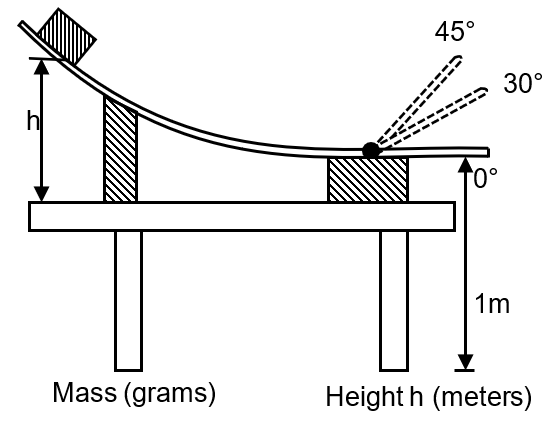
| Mass (grams) | Height h (meters) | |
| Block 1 | 200 | 0.4 |
| 200 | 0.77 | |
| 200 | 1.2 | |
| Block 2 | 300 | 0.4 |
| 300 | 0.77 | |
| 300 | 1.2 |

Know your College Admission Chances Based on your Rank/Percentile, Category and Home State.
Get your JEE Main Personalised Report with Top Predicted Colleges in JoSA
Using data from the table, if Block 1 and Block 2 are released at 1.2m, their speeds at the bottom of the track are, respectively :

v = =
Block-1 and Block-2 are released in different cases from a height of 0.77 m. They collide and stick to two different 500 g mass kept near the end of the track. How does the combined speed of Block 2 and the mass compare with the combined speed of Block 1 and the mass.
200 = 700v1
v1 = , v2 = ⇒ v2 > v1
Block-1 and Block-2 are released from h = 0.4 m and h = 1.2 m respectively. Block 1 flies off the track end at 30º and Block 2 at 45º. The ratio of kinetic energy of the Block-1 to that of Block-2 just before hitting the floor is
k1 = m1g (0.4 + 1)
k2 = m2g (1.2 + 1)
= =