
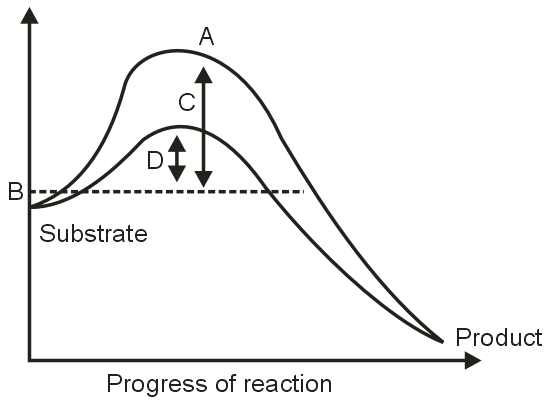
The figure given shows the conversion of a substrate into product by an enzyme. Which one of the four options of reaction labelled as A, B, C and D are identified correctly ?

Know your College Admission Chances Based on your Rank/Percentile, Category and Home State.
Get your JEE Main Personalised Report with Top Predicted Colleges in JoSA

According to the most widely accepted mechanism of enzyme action, the enzyme molecule binds substrate molecule to form a temporary transition state (label A) which rapidly degrades into enzyme molecule and product. The transition state has higher free energy than the substrate (label B) or product molecule. Thus a substrate has to pass through the energy barrier in order to form the product molecule. An uncatalyzed reaction (label C) has to cross a higher barrier as compared to a reaction catalysed by an enzyme (label D). Thus, enzymes work by reducing the free energy barrier between substrates and the product molecules.