
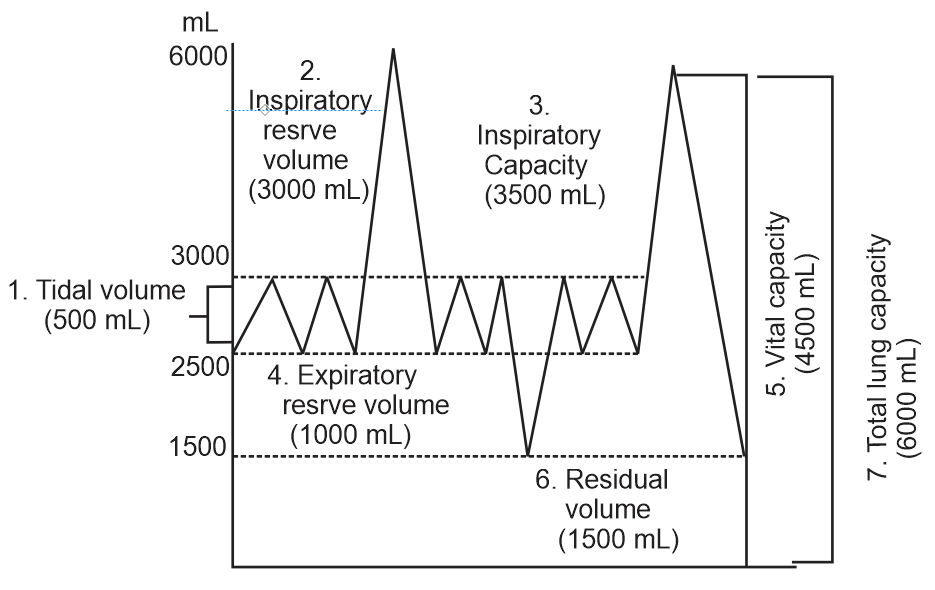
The volume of air in the lungs and the rate at which it is exchanged during inspiration and expiration was measured. The following diagram shows a group of the lung volumes and capacities:
Study the diagram carefully and explain briefly the following:
(a) Tidal volume.
(b) Inspiratory reserve volume.
(c) Expiratory reserve volume.
(d) Vital capacity.
(e) Residual volume.

Know your College Admission Chances Based on your Rank/Percentile, Category and Home State.
Get your JEE Main Personalised Report with Top Predicted Colleges in JoSA

(a) Tidal volume - It is the air breathed in and out in a normal quiet breathing is known as tidal volume. The tidal volume(TV) is 500 mL.
(b) Inspiratory reserve volume - Air that can be drawn in forcibly over and above the tidal air is known as inspiratory reserve volume. It is referred to as IRV or complemental air and is 3000 mL.
(c) Expiratory reserve volume - It is the air that can be expelled out forcibly after a normal expiration. It is referred to as ERV or supplemental air and is 1000 mL.
(d) Vital capacity (VC) - It is the volume of air that can be inhaled and exhaled by maximum inspiration and expiration respectively and is about 4500mL.
(e) Residual volume (RV) - Even after forcible expiration, there is some air left in the lungs and is referred to as residual volume. It is about 1500 mL.