Medical
Biology
Light Reaction
Dark Reaction
Chemiosmotic Hypothesis
Question
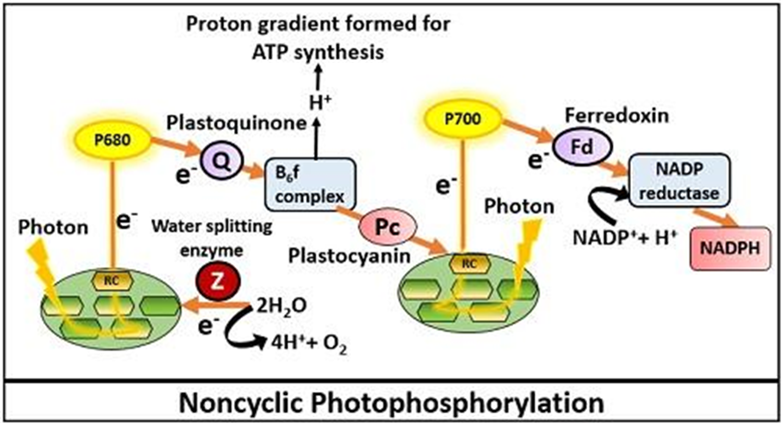
What is photophosphorylation? Distinguish between cyclic and non-cyclic photophosphorylation. Give schematic sketches of both.

Know your College Admission Chances Based on your Rank/Percentile, Category and Home State.
Get your JEE Main Personalised Report with Top Predicted Colleges in JoSA
Solution

The production of ATP by the light-dependent reactions is called photophosphorylation, as it uses light as an energy source.
Photophosphorylation may be either a cyclic process or a non-cyclic process.
Photophosphorylation may be either a cyclic process or a non-cyclic process.
| Cyclic photophosphorylation | Non-cyclic photophosphorylation |
| 1. Predominant in bacteria | Predominant in green plants |
| 2. Only photosystem I (PS1) is involved | Both photosystems 1 and 2 (PS1 and 2) are involved |
| 3. Since PS I is involved, the active reaction centre is P700 | The active reaction centre is P680 |
| 4. The movement of electrons is cyclic | The movement of electrons is non-cyclic |
| 5. This process produces no NADPH and no O2 but it does make ATP | This process produces both NADPH and ATP, and O2 is evolved as a by-product |
| 6. Photolysis (water-splitting) is absent | Photolysis (water-splitting) is present |
| 7. The electrons travel back to PS1 and complete the cycle | The electrons from PS1 are accepted by NADPH, making the cycle incomplete |